How Wind Affects Drone Ground Speed, Flight Time and Range
A drone never flies over the ground — it flies through the air, and the air itself is moving. Whether that movement helps or hurts depends on the angle between the wind and your route, and the effect is often bigger than pilots expect. This guide explains the mechanics with one worked example, then shows what it means for flight time, range and the trip home.
To run the numbers for your own flight, use the Drone Ground Speed & Wind Calculator. It can load the current forecast wind at 10, 80, 120 or 180 m.
Airspeed and ground speed
Airspeed is how fast the drone moves relative to the surrounding air. It is set by the flight mode and the stick: a typical camera drone cruises at 10–15 m/s in normal mode.
Ground speed is how fast the drone moves over the ground — the speed your app shows and the one that decides how long a leg takes.
In still air they are the same. In wind, ground speed is airspeed plus the wind, added as vectors: both the speed and the direction of the wind matter.
Splitting the wind: headwind and crosswind
Any wind can be split into two parts relative to your route:
- the along-track part — a headwind if it blows against you, a tailwind if it blows from behind;
- the cross-track part — a crosswind from the left or right.
A wind at 45° to your route splits evenly: 9.9 m/s at 45° gives about 7 m/s of headwind and 7 m/s of crosswind.
The crosswind costs speed too
A headwind obviously slows you down. A crosswind does too, in a less obvious way. To fly a straight line the drone must point partly into the crosswind so the sideways push is cancelled — this is the crab angle. Multirotors do it automatically when holding a GPS track, which is why pilots rarely notice. But the part of the airspeed spent pushing sideways is no longer moving the drone forward.
The result is the wind triangle:
ground speed = √(airspeed² − crosswind²) − headwind
Worked example
A drone at 15 m/s flies a 2 km leg east (090°). The wind is 9.9 m/s from the north-east (045°).
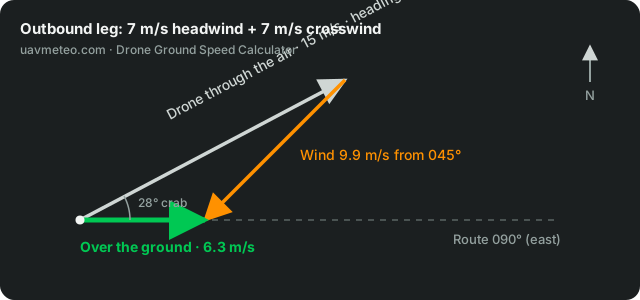
- The wind splits into 7.0 m/s headwind and 7.0 m/s crosswind from the left.
- To cancel the crosswind the drone crabs 28° into the wind, pointing at about 062°.
- The airspeed left along the route is √(15² − 7²) ≈ 13.3 m/s.
- Minus the 7 m/s headwind: 6.3 m/s over the ground.
The 2 km outbound leg takes 5 min 19 s. On the way back (270°) the same wind is a 7 m/s tailwind plus a crosswind from the right: ground speed rises to 20.3 m/s, and the return takes 1 min 39 s.
| Outbound 090° | Return 270° | |
|---|---|---|
| Headwind / tailwind | 7.0 m/s headwind | 7.0 m/s tailwind |
| Crosswind | 7.0 m/s from left | 7.0 m/s from right |
| Crab angle | 28° | 28° |
| Ground speed | 6.3 m/s | 20.3 m/s |
| Time for 2 km | 5:19 | 1:39 |
Round trip: 6 min 58 s. In still air it would be 4 min 27 s — the wind adds 57%.
Note what a quick "15 − 7 = 8 m/s" estimate would have said: the outbound leg at 8 m/s instead of 6.3 m/s, underestimating its time by more than a minute.
A tailwind never pays back a headwind
It feels as if the fast leg should cancel the slow one. It doesn't: you spend longer on the slow leg than on the fast one, so the slow leg dominates. With a 15 m/s drone and an 8 m/s wind, 1 km each way:
| Wind relative to route | Outbound | Return | Round trip vs still air |
|---|---|---|---|
| Head-on | 7.0 m/s | 23.0 m/s | +40% |
| 45° | 8.2 m/s | 19.5 m/s | +29% |
| Straight across | 12.7 m/s | 12.7 m/s | +18% |
Every wind makes an out-and-back flight slower, and a wind in line with the route is the most expensive.
What it means for battery and range
Time in the air is what empties the battery. Two consequences follow:
- Range shrinks with wind. If the wind adds 40% to the round-trip time, the distance you can safely fly out and back shrinks by roughly the same proportion — and more, because pushing into a headwind also draws more power.
- The dangerous leg is the one flown last. If the wind is behind you on the way out, the flight feels effortless, and the slow, power-hungry headwind leg comes when the battery is lowest. This is how many drones are lost in wind.
Plan the first leg into the wind when you can, and set your turn-back point from a headwind return, not from the outbound experience. The Return-to-Home Calculator checks whether the battery you have left covers the trip home.
Use the wind at your flying height
Forecast wind is usually quoted at 10 m. At 100–120 m it is often 1.5–2 times stronger, and it can come from a different direction. In the head-on example above, a 12 m/s drone meeting 4 m/s at 10 m would make 8 m/s outbound — but if the wind at 120 m is 9 m/s, it makes only 3 m/s, and a 1.5 km leg takes over eight minutes instead of three.
Always run the numbers with the wind at the height you will fly. See why wind can be stronger at 120 m and the Wind at Altitude tool.
When the drone can't make progress
If the crosswind is as strong as the airspeed, the drone must point straight into the wind just to stop drifting; nothing is left to move it forward. The same happens when a headwind equals the airspeed. Long before that point the margins are gone: gusts will push the drone back, and the flight controller has little authority left. Many pilots treat a wind above about two-thirds of cruise speed at flying height as a reason to stay short and close, or not to fly — compare it with what your drone's wind rating really means.
FAQ
Does a drone drift sideways in a crosswind?
In GPS-assisted flight, no — the flight controller crabs into the wind automatically to hold the track, so the drone's nose (or body) points slightly off the route. In manual/ATTI mode without position hold, it drifts with the wind unless you correct.
Should I fly faster into a headwind?
Usually yes, within the drone's limits. A higher airspeed shortens the time spent in the headwind; flying slower keeps the drone in the air longer for the same distance. Sport mode can be the safer choice on a strong headwind return, if the battery margin allows.
Is ground speed in my flight app the same as airspeed?
No. Consumer flight apps show ground speed from GPS. If it reads much lower in one direction than the other, the difference is the wind — a useful live check on the forecast.
Related: wind speed vs gusts, why wind direction matters for drones and wind shear.
Sources
- FAA, Pilot's Handbook of Aeronautical Knowledge — chapter 16, "Navigation" (wind triangle, wind correction angle, ground speed).
- Forecast wind at height: Open-Meteo, as listed on our Data Sources page.
This guide is general information for planning, not aviation regulation.